Realisation Infrastructure is all you need
Why civilisation's bottleneck is no longer invention, and what it takes to build the machinery of realisation.
The Question That Won’t Go Away
In 2000, Jeffrey Pfeffer and Robert Sutton asked why organisations that know better so rarely do better (Pfeffer & Sutton, 2000). The question wasn’t rhetorical. It was existential: if knowledge doesn’t change behaviour, then everything we invest in research, education and training is running into a wall we refuse to see.
A quarter of a century later, the wall is still standing. And it has a name in the academic literature: the Research-Practice Gap, the systematic failure of validated knowledge to become lived practice. I adopt the term, and I widen it. Because the same gap that separates journals from boardrooms also separates a seller’s training from their next customer conversation, and a civilisation’s science from its institutions. The research-practice gap exists at every scale: in a conversation, in an organisation, in a market ecosystem, in a polity.
For most of history, humanity’s constraint was discovery. We did not know how disease spread, how organisations learn, how cooperation scales. That constraint has inverted. The most important ideas of our time are researched: organisational ambidexterity, psychological safety, plural technology, privacy-preserving data collaboration, AI that augments rather than replaces human cooperation. What is missing is the craft of making them real. Civilisation’s bottleneck is no longer invention. It is realisation.
The Gap Is Measured, Not Metaphorical
This is not a niche academic complaint; the gap is quantified. In medicine, it takes an average of 17 years for research evidence to reach routine clinical practice, and fewer than half of evidence-based interventions are ever broadly implemented (Rubin, 2023; Dollar et al., 2025). Only about one in seven evidence-based interventions crosses the “valley of death” into real-world use (Zullig et al., 2023). In management, the picture is arguably worse: Rousseau (2006) diagnosed the failure of organisations to base practices on the best available evidence, and two decades later systematic reviews still find the gap intact, persistent and structural (Negt et al., 2024; Banks et al., 2021).
The most sobering result comes from an overview of 86 systematic reviews of gap-closing strategies: isolated interventions achieve small effects at best, and the field must shift toward building “situated, relational and organisational capability” to use research (Boaz et al., 2024). Read that again. After decades of effort, the best available synthesis says: stop shipping messages, start building capability.
Why Knowledge Doesn’t Travel: Five Reasons
Why does the gap persist against so much goodwill? The research converges on five reasons.
First, science and practice are two different systems. Kieser and Leiner (2009) argued from systems theory that the rigour-relevance gap is unbridgeable: science optimises for truth within peer-reviewed discourse, practice for viable decisions under time pressure; messages between them can only “irritate”, never transfer. Hodgkinson and Rousseau (2009) replied with documented counter-examples of partnerships that produced knowledge both rigorous and useful. The productive reading of this debate is not that one side won. It is that bridging never happens by default; it requires deliberately built structures. Which is why Bansal et al. (2012) concluded that closing the gap “is beyond the capabilities and scope of most individuals” and called for intermediary organisations purpose-built to span the boundary.
Second, nobody is paid to close it. Academics are rewarded for publications, not adoption; practitioners for quarterly results, not evidence quality (Bartunek & Rynes, 2014; Olenick & Somers, 2018). An open gap with no owner stays open.
Third, dissemination is a fallacy. The oldest and most robust finding in implementation research: passive dissemination, publishing, mailing guidelines, giving lectures, is generally ineffective at changing professional behaviour (Bero et al., 1998). Knowledge does not travel by being made available. Realisation is a capability of the receiving system, not a property of the message: precisely what Cohen and Levinthal (1990) formalised as absorptive capacity. You cannot download what you have no muscles to metabolise.
Fourth, awareness is not belief. Practitioners who know of well-replicated findings often simply refuse to believe them, especially when the findings threaten identity, self-interest or cherished convictions (Rynes et al., 2018). The gap is not only cognitive and structural. It is emotional and political.
Fifth, and most striking: the gap-closing discipline has a gap of its own. Implementation science, founded to close the research-practice gap in healthcare, barely uses its own findings in real implementation efforts (Westerlund et al., 2019), and it accumulates frameworks faster than validated insight (Wensing & Grol, 2019). I call this the recursion problem, and I treat it as a design requirement: any serious attempt at the Research-Practice Gap must explain why it will not simply reproduce the gap one level up.
One Signature, Four Scales
The mistake is to treat the gap as one thing. It is one pattern: knowledge present, behaviour unchanged. But the binding constraint differs by scale, and that changes everything about the remedy. There are four scales, and the fourth is where the pattern becomes civilisational.

Scale 1: The Knowledge-Doing Gap of the Individual
Pfeffer and Sutton named the pattern at the level of people and firms; building on their Knowing-Doing Gap, I use the term Knowledge-Doing Gap for the individual scale: smart people who know what to do and do not do it. The expertise literature explains why knowing is structurally insufficient. Experience and accumulated knowledge predict observed performance only weakly (Ericsson, 2008). What produces reliable execution is deliberate practice: individualised, feedback-rich, effortful training on tasks just beyond current ability (Ericsson, Krampe & Tesch-Römer, 1993). The magnitude is debated; Macnamara et al. (2016) found practice explains far less variance than originally claimed, while Ericsson and Harwell (2019) showed the effect roughly doubles when practice is measured as originally defined. The direction is not debated: no serious account of skilled performance treats declarative knowledge as sufficient.
It gets worse. At the moment of truth, declarative knowledge is actively harmful. Masters (1992) demonstrated that performers with large stocks of explicit knowledge are more likely to break down under pressure, because stress triggers conscious reinvestment in rules that disrupts automated skill: one of the classic routes to choking (DeCaro et al., 2011). The remedy is equally well documented. Training under simulated pressure produces a medium-to-large improvement in performance under real pressure, with a meta-analytic effect of g ≈ 0.67 (Low et al., 2020). Practising “harder than reality” is not a martial-arts metaphor. It is the evidence-based prescription.
Corporate training ignores nearly all of this. Whether learning transfers to the job depends less on the course than on the surrounding system: motivation, supervisor and peer support, opportunity to perform (Blume et al., 2010; Hughes et al., 2020). Without that system, most acquired learning decays within a year. This is the precise diagnosis behind Sales Kung Fu 销售功夫: sellers trained in Challenger, MEDDICC or Solution Selling know the methodology and still fail to execute in high-stakes customer moments, because communicative impact under pressure is a matter of unconscious competence, not knowledge. The 7 Gates and 16 Skills exist to convert knowing into embodied doing: repetition, feedback, pressure. Kung Fu in the literal sense, skill acquired through practice.
The bottleneck at this scale is embodiment. Knowledge must become procedural, automatic and pressure-proof. Nothing but practice does that.
Scale 2: The Innovation-Realisation Gap of the Organisation
Move up one level and the pattern repeats with different machinery. Organisational ambidexterity is among the most validated ideas in management science: hundreds of studies link the capacity to explore and exploit simultaneously to innovation and performance, with effects that are real but context-dependent and mediated by innovation (O’Reilly & Tushman, 2013; Junni et al., 2013; Marín-Idárraga et al., 2025). Organisations know this. Executives can recite it. And still they fail at it; the Innovator’s Dilemma persists three decades after Christensen named it.
Why? Because at this scale the gap does not live in individual skulls. It lives in the operating system: structures, routines, incentives, governance. Durisin and Todorova (2012) provide the cleanest demonstration. They studied firms applying ambidexterity theory, a theory that is both rigorous and relevant, “neither lost in nor lost before translation”, and found managers still implemented it wrong: they overlooked the process dimension, failed to differentiate cultures, mismanaged reintegration. Even perfect knowledge transfer does not survive contact with organisational routines. Secchi and Camuffo (2019) found the same for lean: implementations fail even when every known barrier is absent, because the failure is built into how the implementation process itself is organised.
There is a second, quieter force that keeps the operating system frozen: the perception of risk. Status-quo bias is one of the most robust findings in decision research (Samuelson & Zeckhauser, 1988): doing nothing feels safer than doing something, because the costs of change are visible, immediate and attributable, while the costs of standing still are diffuse and deferred. Organisational alignment amplifies the bias: nobody was ever fired for defending the status quo. And exploration demands a kind of courage that exploitation never does. But that felt safety is priced against yesterday’s world. When the outside world accelerates, technology cycles compressing, AI rewriting cost structures quarterly, the calculus inverts: the status quo becomes the biggest bet in the portfolio, and the credo has to change from preserving what is to survival of the fittest, where the fittest are the fastest to adapt. Closing the organisational gap is therefore never only an engineering problem. It is a courage-and-alignment problem: making the true risk of standing still visible, and making change feel as safe as it actually is.
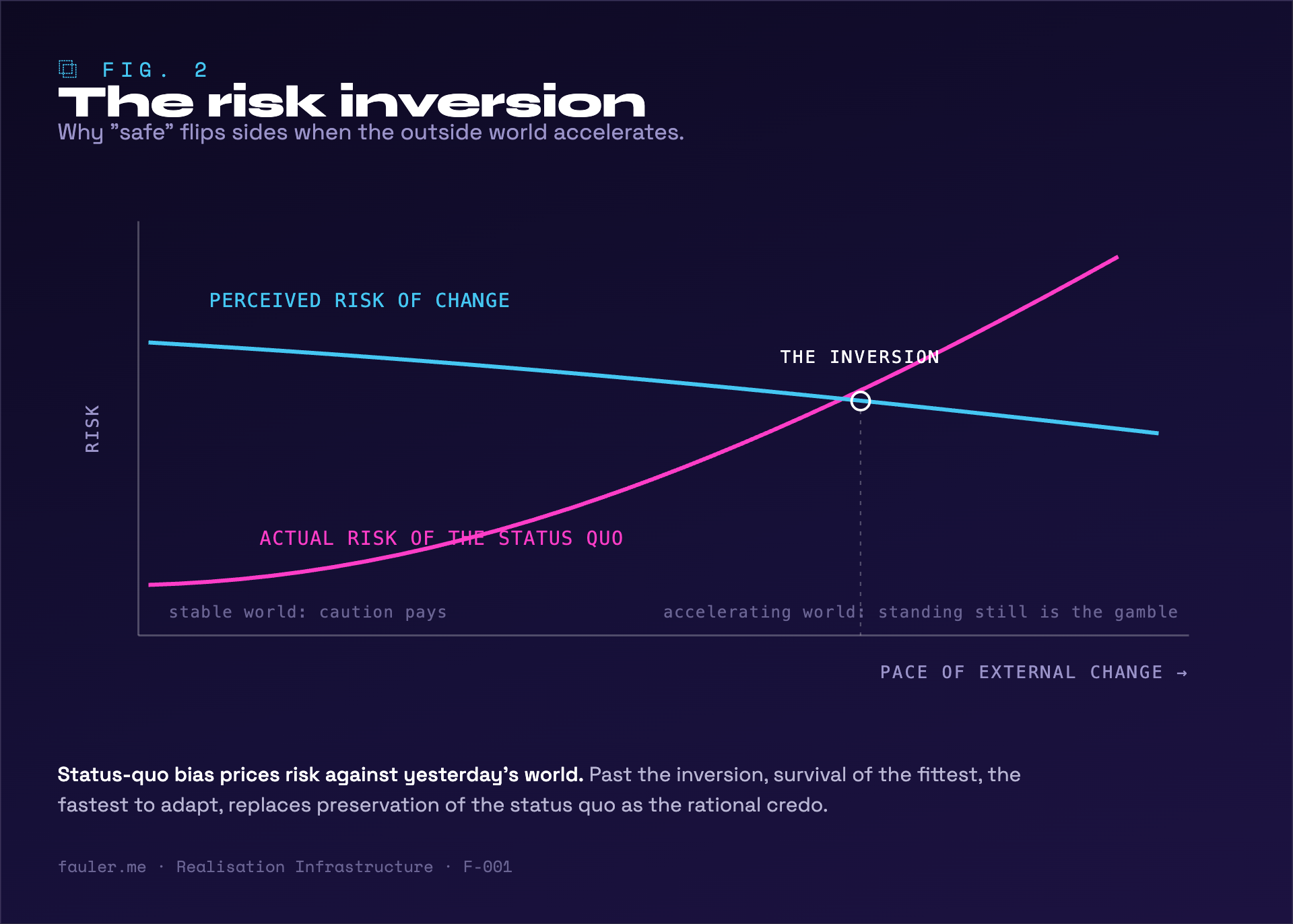
This is where the two programmes I develop elsewhere come in, and they deserve more than a passing mention. Software as organisational Change (SaoC), the companion essay to this one, is the thesis that enterprise software is not a tool that supports change but organisational change itself, in executable form. If the gap lives in the operating system, then the carrier of change must install into the operating system. The evidence that software can carry evidence into behaviour where documents cannot is strongest in medicine, where decision support embedded at the point of decision produces consistent improvements in care across hundreds of trials (Kwan et al., 2020), and where effectiveness depends on design: advice inside the workflow, at the moment of choice (Roshanov et al., 2013). The principle generalises. A guideline asks for compliance; a workflow is compliance. It is also what Maples and Ziebelman (2024) describe from the venture side as inflections: external, usually technological changes that give change agents the power to alter how people think, feel and act. Pattern-breaking founders do not push harder against the status quo. They harness an inflection that makes new behaviour natural. SaoC is the enterprise version of that argument: use the software adoption moment, the one moment when an organisation expects and budgets for behavioural change, as the vehicle for the organisational design change the research prescribes. Wu Wei: do not force change against the grain; ride the inflection where change wants to happen anyway.
Ambidextrous Organisation Acceleration (AOA) is the research-and-measurement programme built on top of SaoC. It operationalises ambidexterity on six organisational scales across four universal levers: leadership, networks, culture, psychological safety. And it instruments every deployment, so that exploration capacity stops being a survey answer and becomes an operational metric with a baseline, an intervention and a benchmark. SaoC installs the change; AOA measures whether it took hold, and feeds what works back into the next deployment. Together they are the answer to Durisin and Todorova’s finding: if even perfect knowledge transfer fails in implementation, then implementation itself must become the instrumented, evidence-generating act.
The bottleneck at this scale is the operating system. Knowledge must become routine, workflow and measurable practice. Software is the only change medium that installs.
Scale 3: The Research-Practice Gap of the Ecosystem
At the top scale, the gap is institutional. Between the research system that produces validated knowledge and the practice system that could realise it, there is no functioning feedback loop. Research studies organisations retrospectively and publishes. Practitioners intervene without data on whether interventions work. Neither learns from the other at operational tempo. The 17-year lag is not caused by slow readers; it is caused by missing infrastructure.
The literature is clear about what the infrastructure has to be. Boundary-spanning intermediary organisations that co-produce knowledge with both sides, rather than brokering finished parcels across (Bansal et al., 2012; Wesselink et al., 2020). Research-practice partnerships with genuine boundary infrastructure: shared routines, shared artefacts, shared measures (Farrell et al., 2022). And increasingly, data collaboratives: cross-organisational partnerships that pool data for shared intelligence (Klievink et al., 2018; Bartolomucci et al., 2025), made newly feasible by privacy-preserving techniques; federated learning and its relatives let institutions share knowledge, not data (Loftus et al., 2022). The literature is equally clear about the failure modes. Individual knowledge brokers burn out in the in-between world (Kislov et al., 2017). Living labs proliferate but rarely measure whether they deliver (Paskaleva & Cooper, 2021). Co-production is celebrated but seldom rigorously evaluated (Grindell et al., 2022). Boundary work without measurement discipline reproduces the gap it was built to close: the recursion problem again.
The bottleneck at this scale is feedback infrastructure. Knowledge must flow in both directions, continuously, with the incentive problem solved by making participation immediately valuable to every party.
Scale 4: The Governance Gap of the Polity
One scale remains, and it is the one where the stakes are highest. Democracies possess a rich, validated repertoire of institutional innovations. Deliberative mini-publics measurably improve participants’ knowledge, efficacy and mutual understanding, and their macro-political uptake has been mapped for two decades (Goodin & Dryzek, 2006). Mechanism design has produced collective-choice instruments with near-optimal theoretical properties: quadratic voting robustly outperforms one-person-one-vote in welfare terms (Lalley & Weyl, 2018; Weyl, 2017), works with real people in real settings (Quarfoot et al., 2017), and quadratic funding extends the principle to public goods provision (Buterin, Hitzig & Weyl, 2019), with field evidence accumulating from Gitcoin’s funding rounds. The knowledge exists. The realisation does not: of the hundreds of citizens’ assemblies of the “deliberative wave” (OECD, 2020), only a handful lead to documented policy reforms (Ubertino et al., 2024), the evidence for spillover into mass democracy remains tentative (van der Does & Jacquet, 2021), and quadratic mechanisms have, in the words of the field itself, “not yet found many real-life applications”. I call this fourth instance the Governance Gap: validated institutional mechanisms that remain pilots.
Why? The same five reasons, in institutional costume. Fung (2015) names the classic diagnosis: absence of systematic leadership, no elite or popular consensus on the place of participation, and innovations granted limited scope and power. The dissemination fallacy reappears as “rhetorical participation”: platforms and processes that perform openness without consequence (Santini & Carvalho, 2019). And the operating-system problem reappears with brutal clarity in Victoria, Australia, where legislation mandating deliberative engagement for all 79 councils met path dependency head-on: 92% of councils simply continued the practices the law had just removed (Savini, 2026). A statute asks for compliance. An institutional routine is compliance. The isomorphism with the organisational scale is exact.
And so are the closing mechanisms. Taiwan is the existence proof. There, deliberation was not disseminated; it was installed: the vTaiwan process and the Polis platform embedded citizen input directly into the workflow of legislation, scaling deliberation while cultivating consensus rather than division, with documented legislative effect (Hsiao et al., 2018; Small et al., 2021; Tseng, 2022). The comparative evidence on when digital participation works reads like a restatement of Realisation Infrastructure: consequential transparency, trust coherence, and institutional responsiveness; visible pathways from citizen input to government action (Myeong et al., 2026). Practice, software, feedback. The frontier of the field is precisely embedding and routinising these processes in standing institutions (Ainscough et al., 2024; Fiket et al., 2026), and its honest self-critique notes where the software still flattens nuance into binaries (Moats et al., 2023): measurement discipline is needed here as everywhere.
This is where RadicalxChange and ⿻ Plurality enter the picture, in two roles at once. As a movement, they are the fourth scale’s Catalysts: RxC carries the mechanism research, and Plurality (Weyl & Tang, 2024) articulates the thesis that technology can be designed for collaboration across difference rather than for capture; Taiwan wrote the reference implementation. And as a constitution, they guard the other three scales. Any realisation flywheel with a data network effect faces a temptation the platform economy has already succumbed to: becoming the extractive intermediary that captures the surplus of a nominally positive-sum game. The plural principles, data sovereignty, co-ownership, interoperability, exit, are what keep the surplus with the players; the Plural Stack Assessment is the measurement discipline that tests whether a service delivers those properties by design rather than by promise. Fairness by design, not by promise: without it, no granted trust; without granted trust, no data contributions; without contributions, no evidence flywheel.
The bottleneck at this scale is constitutional embedding. Knowledge must become institution, and institutions change on the slowest clock of all: legitimacy. The remedy is plural technology carried by movements, proven in reference implementations, and measured without mercy.
Content Is King, Context Is King Kong, Collaboration Is the Kingdom
The four concepts, the Knowledge-Doing Gap closed by Sales Kung Fu, the Innovator’s Dilemma addressed by Software-as-organisational-Change, the Research-Practice Gap closed by data collaboration, and the Governance Gap addressed by plural technology, are distinct in mechanism, isomorphic in structure, and coupled in operation (Fig. 1).
They are isomorphic: at every scale, knowledge is present and behaviour unchanged, because transfer was treated as communication when it is actually capability-building. One phenomenon, four substrates: nervous systems, organisations, markets, institutions. The four academic literatures barely cite each other, which is itself a research-practice gap and part of why the pattern goes unrecognised. A statute that changes no council routine (Savini, 2026) fails for the same reason as a guideline that changes no clinical routine (Bero et al., 1998) and a training that changes no sales conversation: dissemination without installation.
They are distinct: the bottlenecks differ, so the remedies do not substitute. Deliberate practice cannot fix an exploitation-governed budget process. A software platform cannot give a seller unconscious competence in a boardroom. A data collaborative cannot install a workflow. A movement cannot practise on anyone’s behalf. Treating them as interchangeable, sending people to training to fix a structural problem, buying software to fix a skill problem, is exactly how organisations waste transformation budgets.
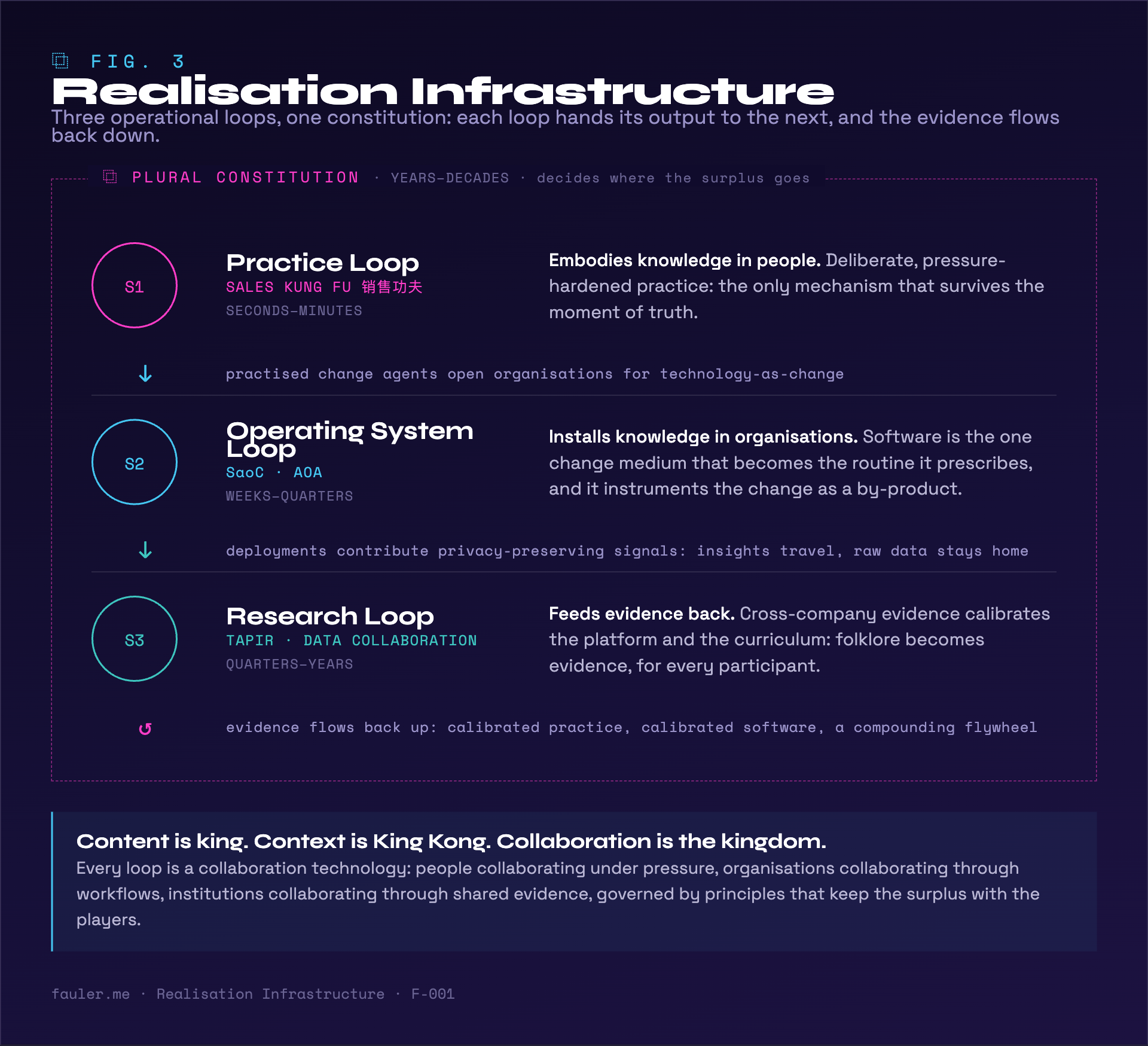
And they are coupled, which is the strategic point. The gaps compound downward: unrealised research means organisations design interventions blind; unreformed operating systems mean individual practice has nowhere to transfer. But the closings compound upward, and here is how the pieces fit together into one system. The practice loop produces people who can carry change into organisations. The operating system loop turns each of those organisations into an instrumented site where change is installed and measured. The research loop pools those measurements, privacy-preserving, insights only, into evidence that calibrates both the software and the practice. And the plural constitution above them decides, at every level, where the surplus goes. Each loop hands its output to the loop above; each loop above sends evidence back down.
Look at the closing mechanisms once more and a deeper pattern appears: every one of them is a collaboration technology. Deliberate practice is collaboration between practitioner and Sifu, feedback for feedback. SaoC works only when vendor and customer stop transacting and start co-designing the change the software carries. Data collaboratives are collaboration incorporated: organisations that compete in their markets and still cooperate on evidence, because the game is positive-sum by construction. And plural technology is nothing else than collaboration across difference, scaled to the polity. That is the ultimate goal behind all four scales: not better messages, not even better tools, but ever-wider circles of collaboration. Individuals with coaches, teams with teams, firms with firms, institutions with citizens; each circle held together by the same constitutional guarantee that nobody’s contribution becomes somebody else’s capture. Content is king. Context is King Kong. Collaboration is the kingdom.
What If Realisation Had Infrastructure?
What if the moments of truth in a customer conversation were practised as systematically as a musician practises scales? What if every software deployment doubled as an instrument, measuring whether the organisational change it carries actually takes hold? What if the organisations investing in ambidexterity contributed their signals, privacy-preserving, on-premises, insights only, to a shared evidence base that answered the questions no single firm and no retrospective study can answer: is 3.8 psychological safety good, what intervention works at what dose, where is our exploration capacity drifting? What if researchers could validate and refine their models in years instead of decades, and practitioners could see in real time whether their interventions work? What if the same architecture that realises ambidexterity research in companies could help realise democratic innovations in institutions, deliberation installed in the workflow of legislation the way decision support is installed in the workflow of care? What if closing the gap at one scale made it cheaper to close at the next?
That system has a name.
Realisation Infrastructure
Realisation Infrastructure is the machinery that turns validated knowledge into lived practice: three operational loops, one constitution, one system (Fig. 3).
Our Point of View. Civilisation’s bottleneck is no longer invention but realisation, and realisation is a capability that must be built at three scales simultaneously. The practice loop (Sales Kung Fu 销售功夫, seconds to minutes) embodies knowledge in people; deliberate, pressure-hardened practice is the only mechanism that survives the moment of truth. The operating system loop (SaoC and the AOA programme, weeks to quarters) installs knowledge in organisations; software is the one change medium that becomes the routine it prescribes, and AOA measures whether the change takes hold. The research loop (Tapir’s Data Collaboration, quarters to years) feeds evidence back; a boundary organisation whose boundary object is a privacy-preserving measurement platform, built with research partners such as LMU Munich. And above the loops sits the Plural Constitution (years to decades): the ⿻ principles of RadicalxChange and Plurality that decide where the surplus goes, with the Plural Stack Assessment as their measurement discipline. We do not operate a fourth loop at the polity scale; we align with the movement that does, contribute measurement, and let its principles govern our own architecture.
The Problem. Each loop alone reproduces a known failure. Training without transfer systems decays within a year. Software without practised change agents dies in the 74% of buying groups with unhealthy conflict. Research without operational data waits 17 years. The gaps compound downward; only a coupled system compounds upward.
What Makes This Different. The loops feed each other. Practitioners open organisations for technology-as-change; deployments instrument organisations as a by-product of operations, not as an extra study; cross-company evidence calibrates both the platform and the coaching, so the Sifu’s curriculum stops being folklore and becomes evidence. Every participating organisation strengthens the evidence for all: a data network effect, and cooperation becomes the winning strategy. Fairness is structural, not promised: raw data stays on-premises, only aggregated insights travel, and the surplus flows to the players, not to an extractive intermediary. This is the Plural Constitution at work inside the flywheel: the same principles that Taiwan installed in legislation, applied to enterprise people data, and tested the way the Plural Stack Assessment tests any service: by design, not by promise. And the system accepts the recursion test: a gap-closing system must demonstrably close its own gap. We practise our own Gates, deploy our own change, measure our own interventions.
Our Commitment. Sense of urgency with actions, perseverance with results. We will build the measurement infrastructure openly, publish what we learn, separate hypothesis from proof, and let the evidence calibrate the method rather than the other way round.
Six Threads Worth Pulling
Six findings from the literature deserve flagging, because each is either an opportunity or a warning.
AI is halving the wrong half of the gap. A wave of work applies AI to evidence synthesis and implementation (Trinkley et al., 2024; Nilsen et al., 2024; Sousa et al., 2026). This will compress the knowledge-availability portion of the 17-year lag dramatically. But availability was never the binding constraint; embodiment, operating systems and feedback loops are. AI will make the Research-Practice Gap more visible and more painful: organisations will have instant access to what works and still not do it. That is a tailwind for every practice- and infrastructure-based approach. There is a mirror risk: if AI homogenises outputs and shifts organisations toward exploitation, it may widen the organisational gap while narrowing the informational one. This is the open flank our AOA research agenda targets.
The adherence lens gives realisation a quality standard. Banks et al. (2021) propose grading research by prescriptive readiness and designing adherence support the way medicine does: make the recommended behaviour possible, easy, normative, rewarding, sometimes required. Every insight a realisation system ships should carry its evidence grade and its adherence design.
The scholar-practitioner is an institutional role, not a personality. The literature keeps rediscovering that gaps close through people and organisations holding dual citizenship: “working in the middle” (Lawler & Benson, 2020), scholar-practitioners as translators (Moore et al., 2026), boundary organisations with standing (Bansal et al., 2012). The practising Master is not branding. It is the empirically indicated position from which realisation work is done.
Measurement discipline is the differentiator in a soft field. Living labs, co-production and knowledge brokering all draw the same critique: widely celebrated, rarely evaluated (Paskaleva & Cooper, 2021; Grindell et al., 2022). A realisation system that measures its own effect, baseline, intervention, benchmark, drift, is not just better. It is categorically different in a market where incumbents cannot prove anything.
Democracy is the fourth scale’s proof and its warning. Taiwan shows that installing deliberation into institutional workflow works (Hsiao et al., 2018; Small et al., 2021); Victoria shows that legislating it without changing routines does not (Savini, 2026). The Governance Gap will not be closed by better mechanisms alone, and everyone building realisation systems for organisations should study why: the constraints are the same one scale up.
The recursion test is the proof point. The implementation-science paradox (Westerlund et al., 2019) is the standing warning: systems built to close gaps tend to reproduce them one level up. A system that survives recursive self-application is rare enough to carry a whole category.
Who This Is For
If you lead an organisation that has read the research and still cannot execute it; if you sell technology and have understood that you are really selling organisational change; if you research ambidexterity, psychological safety or implementation and are tired of waiting 17 years for your findings to matter; if you design democratic mechanisms or plural technology and want them installed rather than piloted; if you believe measurement beats folklore and cooperation beats extraction: you’re exactly who I’m looking for. Not as a customer. As a co-creator of Realisation Infrastructure, at whichever loop is yours: practice, operating system, or research.
The Question Behind the Question
The Innovator’s Dilemma told executives why great firms fail. The Knowledge-Doing Gap told them why smart people don’t act. The Research-Practice Gap names the pattern behind both and locates today’s civilisational bottleneck: not invention, but realisation. The deeper question is not whether we can close the gap. The evidence says we can: through practice at the scale of a conversation, software at the scale of an organisation, data collaboration at the scale of an ecosystem, and plural technology at the scale of a polity. The deeper question is whether we will build institutions whose purpose is realisation itself. If you can believe it, you can achieve it. But only if you practise it, install it, and measure it.
Would you like to build it with us?
Sources
Ainscough, J. et al. (2024). Embedding deliberation: guiding the use of deliberative mini-publics in climate policy-making. Climate Policy. DOI: 10.1080/14693062.2024.2303337
Banks, G.C. et al. (2021). Changing the Conversation on the Science-Practice Gap: An Adherence-Based Approach. Journal of Management. DOI: 10.1177/0149206321993546
Bansal, P., Bertels, S., Ewart, T., MacConnachie, P. and O’Brien, J. (2012). Bridging the Research-Practice Gap. Academy of Management Perspectives, 26(1). DOI: 10.5465/amp.2011.0140
Bartolomucci, F. et al. (2025). Understanding data collaboratives ten years after their definition. Electronic Markets. DOI: 10.1007/s12525-025-00831-6
Bartunek, J.M. and Rynes, S.L. (2014). Academics and Practitioners Are Alike and Unlike. Journal of Management, 40(5). DOI: 10.1177/0149206314529160
Bero, L.A., Grilli, R., Grimshaw, J.M., Harvey, E., Oxman, A.D. and Thomson, M.A. (1998). Closing the gap between research and practice: an overview of systematic reviews of interventions to promote the implementation of research findings. BMJ, 317(7156), 465–468. DOI: 10.1136/bmj.317.7156.465
Blume, B.D., Ford, J.K., Baldwin, T.T. and Huang, J.L. (2010). Transfer of Training: A Meta-Analytic Review. Journal of Management, 36(4), 1065–1105. DOI: 10.1177/0149206309352880
Boaz, A. et al. (2024). “It depends”: what 86 systematic reviews tell us about what strategies to use to support the use of research in clinical practice. Implementation Science, 19. DOI: 10.1186/s13012-024-01337-z
Buterin, V., Hitzig, Z. and Weyl, E.G. (2019). A Flexible Design for Funding Public Goods. Management Science, 65(11).
Christensen, C.M. (1997). The Innovator’s Dilemma. Boston, MA: Harvard Business School Press.
Cohen, W.M. and Levinthal, D.A. (1990). Absorptive Capacity: A New Perspective on Learning and Innovation. Administrative Science Quarterly, 35(1), 128–152. DOI: 10.2307/2393553
DeCaro, M.S., Thomas, R.D., Albert, N.B. and Beilock, S.L. (2011). Choking under pressure: multiple routes to skill failure. Journal of Experimental Psychology: General. DOI: 10.1037/a0023466
Dollar, K.M. et al. (2025). Bridging the research-to-practice gap: Implementation science approaches to transform health care delivery. Psychological Services. DOI: 10.1037/ser0000979
Durisin, B. and Todorova, G. (2012). A Study of the Performativity of the “Ambidextrous Organizations” Theory: Neither Lost in nor Lost before Translation. Journal of Product Innovation Management. DOI: 10.1111/j.1540-5885.2012.00981.x
Ericsson, K.A. (2008). Deliberate practice and acquisition of expert performance: a general overview. Academic Emergency Medicine. DOI: 10.1111/j.1553-2712.2008.00227.x
Ericsson, K.A. and Harwell, K.W. (2019). Deliberate Practice and Proposed Limits on the Effects of Practice on the Acquisition of Expert Performance. Frontiers in Psychology, 10:2396. DOI: 10.3389/fpsyg.2019.02396
Ericsson, K.A., Krampe, R.T. and Tesch-Römer, C. (1993). The role of deliberate practice in the acquisition of expert performance. Psychological Review, 100(3), 363–406. DOI: 10.1037/0033-295X.100.3.363
Farrell, C.C., Penuel, W.R., Coburn, C.E., Daniel, J. and Steup, L. (2022). Learning at the Boundaries of Research and Practice: A Framework for Understanding Research-Practice Partnerships. Educational Researcher, 51(3). DOI: 10.3102/0013189X211069073
Fiket, I. et al. (2026). Towards an Innovative Democracy: Institutionalizing Participation in Challenging Times. Politics and Governance. DOI: 10.17645/pag.11861
Fung, A. (2015). Putting the Public Back into Governance: The Challenges of Citizen Participation and Its Future. Public Administration Review, 75(4). DOI: 10.1111/puar.12361
Goodin, R.E. and Dryzek, J.S. (2006). Deliberative Impacts: The Macro-Political Uptake of Mini-Publics. Politics & Society, 34(2). DOI: 10.1177/0032329206288152
Grindell, C., Coates, E., Croot, L. and O’Cathain, A. (2022). The use of co-production, co-design and co-creation to mobilise knowledge in the management of health conditions: a systematic review. BMC Health Services Research, 22. DOI: 10.1186/s12913-022-08079-y
Hill, L.A., Tedards, E. and Wild, J. (2026). Genius at Scale: How Great Leaders Drive Innovation. Boston, MA: Harvard Business Review Press.
Hodgkinson, G.P. and Rousseau, D.M. (2009). Bridging the Rigour-Relevance Gap in Management Research: It’s Already Happening! Journal of Management Studies, 46(3), 534–546. DOI: 10.1111/j.1467-6486.2009.00832.x
Hsiao, Y.-T., Lin, S.-Y., Tang, A., Narayanan, D. and Sarahe, C. (2018). vTaiwan: An Empirical Study of Open Consultation Process in Taiwan. SocArXiv. DOI: 10.31235/osf.io/xyhft
Hughes, A.M., Zajac, S., Woods, A.L. and Salas, E. (2020). The Role of Work Environment in Training Sustainment: A Meta-Analysis. Human Factors. DOI: 10.1177/0018720819845988
Junni, P., Sarala, R.M., Taras, V. and Tarba, S.Y. (2013). Organizational Ambidexterity and Performance: A Meta-Analysis. Academy of Management Perspectives, 27(4). DOI: 10.5465/amp.2012.0015
Kieser, A. and Leiner, L. (2009). Why the Rigour-Relevance Gap in Management Research is Unbridgeable. Journal of Management Studies, 46(3), 516–533. DOI: 10.1111/j.1467-6486.2009.00831.x
Kislov, R., Wilson, P. and Boaden, R. (2017). The “dark side” of knowledge brokering. Journal of Health Services Research & Policy. DOI: 10.1177/1355819616653981
Klievink, B., van der Voort, H. and Veeneman, W. (2018). Creating value through data collaboratives. Information Polity, 23(4). DOI: 10.3233/ip-180070
Kwan, J.L., Lo, L., Ferguson, J. et al. (2020). Computerised clinical decision support systems and absolute improvements in care: meta-analysis of controlled clinical trials. BMJ, 370:m3216. DOI: 10.1136/bmj.m3216
Lalley, S.P. and Weyl, E.G. (2018). Quadratic Voting: How Mechanism Design Can Radicalize Democracy. AEA Papers and Proceedings, 108. DOI: 10.2139/ssrn.2488763
Lawler, E.E. and Benson, G.S. (2020). The practitioner-academic gap: A view from the middle. Human Resource Management Review, 32(1). DOI: 10.1016/j.hrmr.2020.100748
Loftus, T.J. et al. (2022). Federated learning for preserving data privacy in collaborative healthcare research. Digital Health, 8. DOI: 10.1177/20552076221134455
Low, W.R., Sandercock, G.R.H., Freeman, P., Winter, M.E., Butt, J. and Maynard, I. (2020). Pressure training for performance domains: A meta-analysis. Sport, Exercise, and Performance Psychology. DOI: 10.1037/spy0000202
Macnamara, B.N., Moreau, D. and Hambrick, D.Z. (2016). The Relationship Between Deliberate Practice and Performance in Sports. Perspectives on Psychological Science, 11(3). DOI: 10.1177/1745691616635591
Maples, M. Jr. and Ziebelman, P. (2024). Pattern Breakers: Why Some Start-Ups Change the Future. New York: PublicAffairs.
Marín-Idárraga, D.A. et al. (2025). Ambidexterity and innovation: a systematic and meta-analytic approach to mediating effects on performance. Technology Analysis & Strategic Management. DOI: 10.1080/09537325.2025.2464885
Masters, R.S.W. (1992). Knowledge, knerves and know-how: The role of explicit versus implicit knowledge in the breakdown of a complex motor skill under pressure. British Journal of Psychology, 83(3), 343–358. DOI: 10.1111/j.2044-8295.1992.tb02446.x
Moats, D. et al. (2023). Sorting a public? Using quali-quantitative methods to interrogate the role of algorithms in digital democracy platforms. Information, Communication & Society. DOI: 10.1080/1369118x.2023.2230286
Moore, K. et al. (2026). What Are We Learning About the Research-Practice Gap From HRD Scholars and HRD Scholar-Practitioners? Human Resource Development Quarterly. DOI: 10.1002/hrdq.70019
Myeong, S.-H. et al. (2026). When digital trust collapses: an exploratory comparative framework for citizen involvement in digital governance. Humanities and Social Sciences Communications. DOI: 10.1057/s41599-026-07348-z
Negt, P. et al. (2024). Exploring the gap between research and practice in human resource management (HRM): a scoping review and agenda for future research. Management Review Quarterly. DOI: 10.1007/s11301-023-00397-7
Nilsen, P. et al. (2024). Towards evidence-based practice 2.0: leveraging artificial intelligence in healthcare. Frontiers in Health Services, 4.
OECD (2020). Innovative Citizen Participation and New Democratic Institutions: Catching the Deliberative Wave. Paris: OECD Publishing.
Olenick, J. and Somers, M. (2018). A Systems View of the Scientist-Practitioner Gap. Industrial and Organizational Psychology. DOI: 10.1017/iop.2018.8
O’Reilly, C.A. and Tushman, M.L. (2013). Organizational Ambidexterity: Past, Present, and Future. Academy of Management Perspectives, 27(4). DOI: 10.5465/amp.2013.0025
Paskaleva, K. and Cooper, I. (2021). Are living labs effective? Exploring the evidence. Technovation, 106. DOI: 10.1016/j.technovation.2021.102311
Pfeffer, J. and Sutton, R.I. (2000). The Knowing-Doing Gap: How Smart Companies Turn Knowledge into Action. Boston, MA: Harvard Business School Press.
Quarfoot, D., von Kohorn, D., Slavin, K., Sutherland, R., Goldstein, D. and Konar, E. (2017). Quadratic voting in the wild: real people, real votes. Public Choice, 172. DOI: 10.1007/s11127-017-0416-1
Roshanov, P.S. et al. (2013). Features of effective computerised clinical decision support systems: meta-regression of 162 randomised trials. BMJ, 346:f657. DOI: 10.1136/bmj.f657
Rousseau, D.M. (2006). Is there Such a thing as “Evidence-Based Management”? Academy of Management Review, 31(2). DOI: 10.5465/amr.2006.20208679
Rubin, R. (2023). It Takes an Average of 17 Years for Evidence to Change Practice: the Burgeoning Field of Implementation Science Seeks to Speed Things Up. JAMA, 329(16). DOI: 10.1001/jama.2023.4387
Rynes, S.L., Colbert, A.E. and O’Boyle, E.H. (2018). When the “Best Available Evidence” Doesn’t Win. Journal of Management. DOI: 10.1177/0149206318796934
Samuelson, W. and Zeckhauser, R. (1988). Status quo bias in decision making. Journal of Risk and Uncertainty, 1(1), 7–59. DOI: 10.1007/BF00055564
Santini, R.M. and Carvalho, H. (2019). The rise of participatory despotism: a systematic review of online platforms for political engagement. Journal of Information, Communication and Ethics in Society. DOI: 10.1108/jices-02-2019-0016
Savini, E. (2026). Changing practices, not just rules: Rethinking the institutionalisation of deliberative engagement. Australian Journal of Public Administration. DOI: 10.1111/1467-8500.70048
Secchi, R. and Camuffo, A. (2019). Lean implementation failures: The role of organizational ambidexterity. International Journal of Production Economics. DOI: 10.1016/j.ijpe.2019.01.007
Small, C., Bjorkegren, M., Erkkilä, T., Shaw, L. and Megill, C. (2021). Polis: Scaling deliberation by mapping high dimensional opinion spaces. RECERCA. Revista de Pensament i Anàlisi, 26(2). DOI: 10.6035/recerca.5516
Sousa, M. et al. (2026). The landscape of artificial intelligence tools and platforms for evidence synthesis: a scoping review. Systematic Reviews. DOI: 10.1186/s13643-025-02842-y
Trinkley, K.E. et al. (2024). Leveraging artificial intelligence to advance implementation science: potential opportunities and cautions. Implementation Science, 19.
Tseng, Y.-S. (2022). Algorithmic empowerment: A comparative ethnography of two open-source algorithmic platforms, Decide Madrid and vTaiwan. Big Data & Society, 9(2). DOI: 10.1177/20539517221123505
Ubertino, S. et al. (2024). Democratizing food systems: A scoping review of deliberative mini-publics in the context of food policy. Journal of Agriculture, Food Systems, and Community Development, 13(2). DOI: 10.5304/jafscd.2024.132.019
van der Does, R. and Jacquet, V. (2021). Small-Scale Deliberation and Mass Democracy: A Systematic Review of the Spillover Effects of Deliberative Minipublics. Political Studies, 71(1). DOI: 10.1177/00323217211007278
Wells, R., Howarth, C. and Brand-Correa, L.I. (2021). Are citizen juries and assemblies on climate change driving democratic climate policymaking? Climatic Change, 168. DOI: 10.1007/s10584-021-03218-6
Wensing, M. and Grol, R. (2019). Knowledge translation in health: how implementation science could contribute more. BMC Medicine, 17. DOI: 10.1186/s12916-019-1322-9
Wesselink, A. et al. (2020). Boundary Organizations: Intermediaries in Science-Policy Interactions. Oxford Research Encyclopedia of Politics. DOI: 10.1093/acrefore/9780190228637.013.1412
Westerlund, A., Nilsen, P. and Sundberg, L. (2019). Implementation of Implementation Science Knowledge: The Research-Practice Gap Paradox. Worldviews on Evidence-Based Nursing, 16(5). DOI: 10.1111/wvn.12403
Weyl, E.G. (2017). The robustness of quadratic voting. Public Choice, 172. DOI: 10.1007/s11127-017-0405-4
Weyl, E.G. and Tang, A. (2024). ⿻ Plurality: The Future of Collaborative Technology and Democracy. (CC0.)
Zullig, L.L. et al. (2023). Embedding implementation science in the research pipeline. Translational Behavioral Medicine. DOI: 10.1093/tbm/ibad050
© 2026 Andreas Fauler · Artwork by Totemical · Imprint · Privacy